Erodium neuradifolium Del.
Erodium neuradifolium is an annual, caulescent herb; roots fine ± branching; stems procumbent or ascending, with retrorse or ± patent eglandular hairs and sparse glands.
Leaves: leaves elliptical to oblong, cordiform, pinnatipartite, often the basal segments separated to almost the middle nerve, with eglandular hairs and dense glands; segments 3-5, acute, irregularly dentate or incised-dentate; base leaves with lamina 2-6.5cm, petioles 4-7cm; stipules 3.5-7.5mm, triangular-ovate, brown with a whitish margin, glabrous.
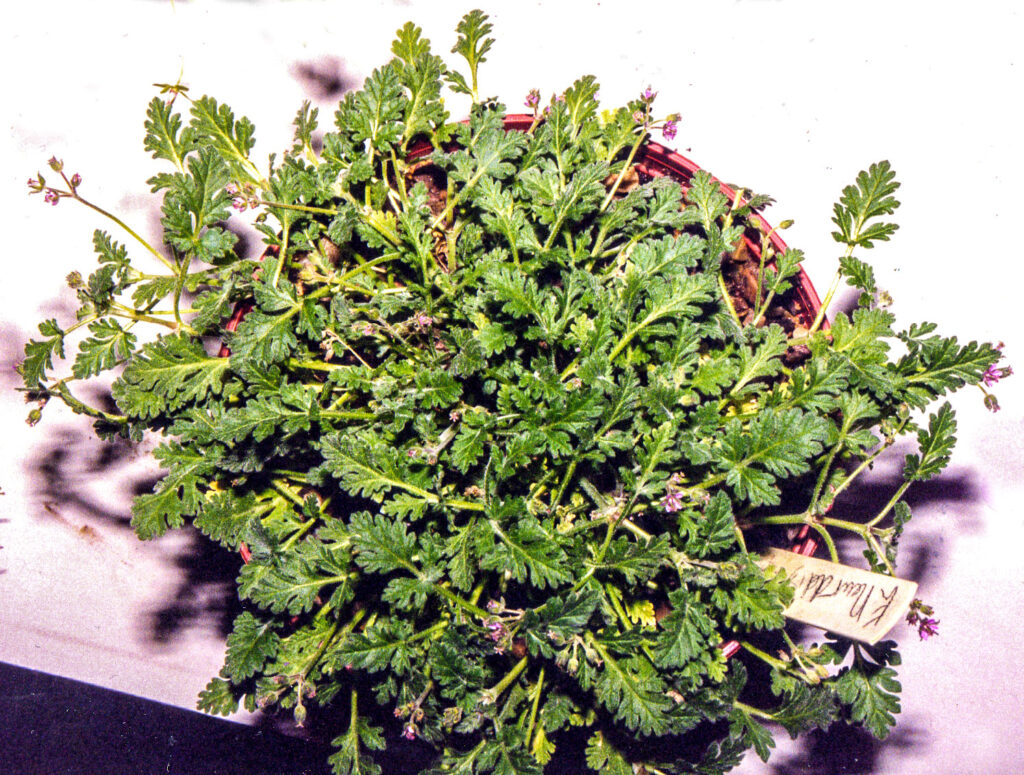
Inflorescence: Umbels of 4-8 flowers, minute; bracts 5-8, 1.5-3mm, free or joined; sepals 3.7-4.8mm, with eglandular hairs and gland on lower surface; mucro 0.4-0.8mm; petals 4-6mm, all alike, pink to dull purple, the uppers without mark at the base, barely longer than sepals; nectaries green, staminodes glabrous, whitish-pink; stamen filaments pink to purple; anthers purple; pollen yellow; stigmas purple.
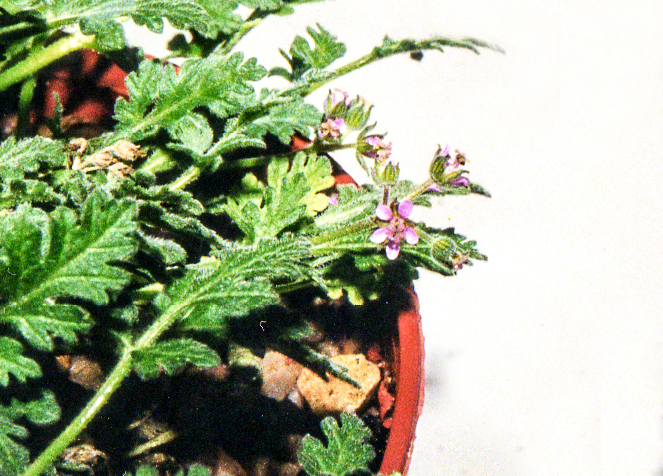
Fruit: Beak 3-4cm, inconspicuously crimson striped at base for ⅔rds of length; mericarp 4-5.2mm; foveole eglandular, with a narrow deep and evident furrow; seed-awn has 8-11 turns. 2n=40 Guitt.
Distribution: Europe, Africa, Asia, Mediterranean; Spain, Portugal, Canaries, Cyprus, Sahara, Algeria, Morocco, Tunisia, Libya, Egypt, Somalia, Saudi Arabia…