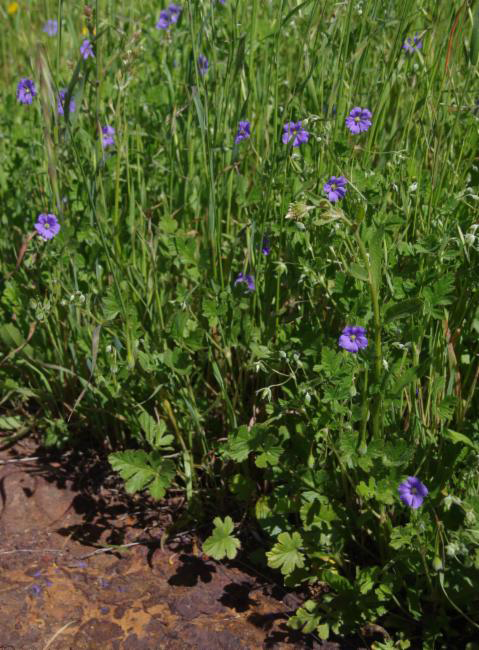
Erodium cygnorum Nees
A sprawling to sub-erect perennial with a thick fleshy taproot; Stems 1 or several 5-60 cm, covered in stiff white simple hairs.
Leaves 1.5-4.0 cm x 0.5-3.0 cm deeply dissected into three principal lobes; median lobe105-4.0 x 0.3-2.0 cm, sinuses cut to the main vein with simple hairs scattered over the surface; petioles slender c. 2 cm; stipules and bracts acute.
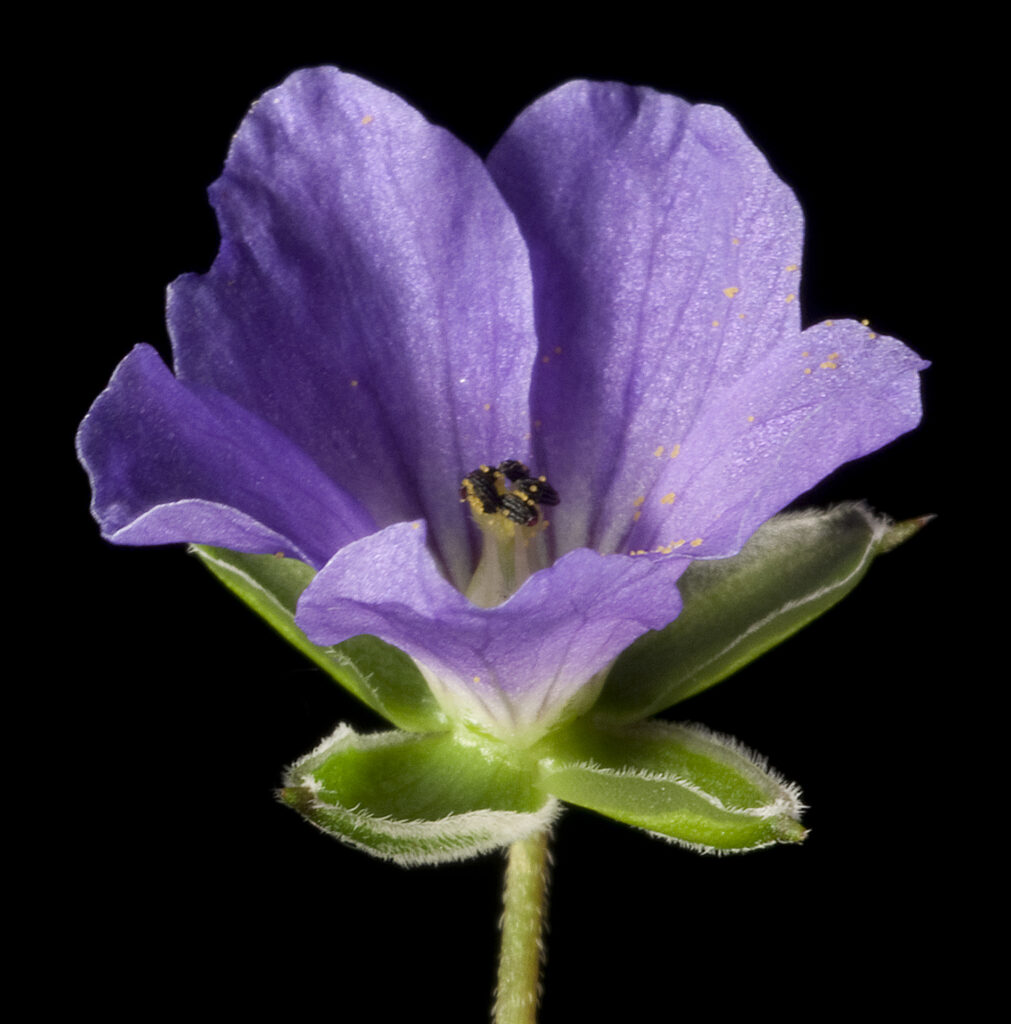
Inflorescence: Flowers blue purple, veined yellow or white, 20 mm across in umbels of 2-5; pedicels almost glabrous but with short white simple hairs just below the calyx; sepals 0.5- 0.9 x 0.2-0.4 mm, oblong-lanceolate to oblong, covered with short white simple hairs, mucro 2mm, flower buds oval, not furry, petals ovate, c. 10 x 5 mm; stamen filaments lanceolate; anthers yellow; stigma green.
Fruit: Mericarp 8-10 mm; foveole with 1-2 folds beneath; beak 5-10 cm.
Distribution: Australia; mostly western Australia but eastwards to Ayer’s Rock, and Lake Gillies in South Australia.
Synonyms: E. angustilobum Carolin – Carolin (1970) distinguished E. angustilobum from E. cygnorum on the basis of its narrow leaf lobes. However, E. cygnorum shows a large variability in leaf shape and size, which includes those with narrow lobes. These forms have no other associated distinctive character, and consequently E. angustilobum is now considered a synonym of E. cygnorum.