Erodium crinitum Carolin
Erodium crinitum is a sprawling or partly erect perennial with a thick, fleshy rootstock. Plants vary from robust to thin tiny single stems, as usual in these ‘weedy’ species. Stems, 1 to several from the crown, 5-50 cm, with scattered stiff white hairs.
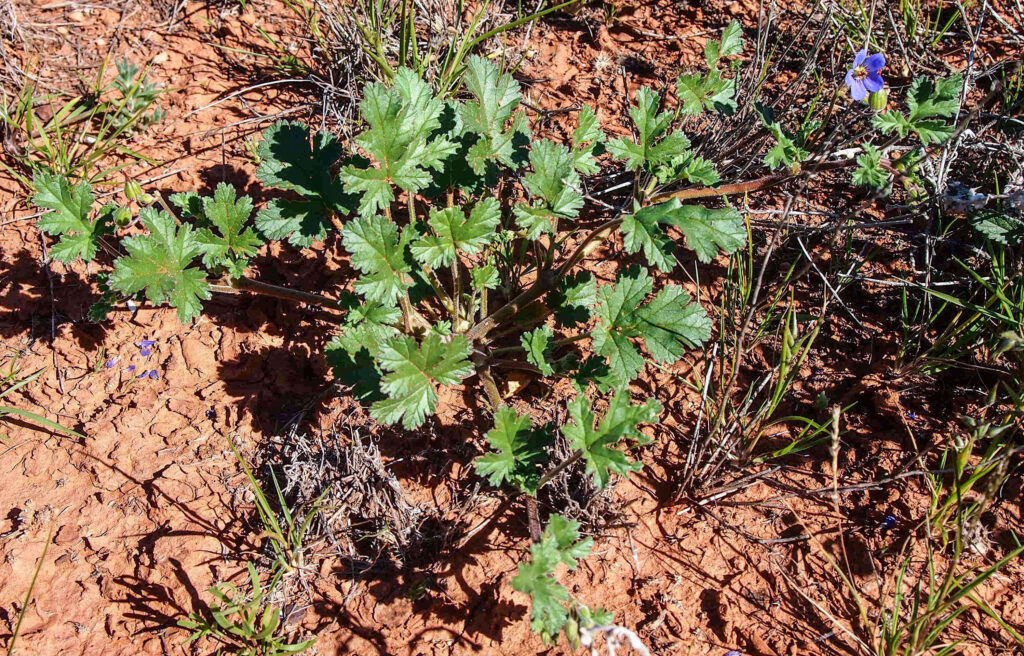
Leaves: 1.5-4.0 cm long, 1.5-3.0 cm wide – triangular in outline, deeply palmately dissected with three principal lobes; median lobe 1.5-4.0 cm long, 1.0-2.5 cm wide; sinuses reaching to the midrib withscattered long white simple hairs; margin toothed; petioles slender with scattered simple hairs, and very short glandular hairs; bracts and stipules acute.
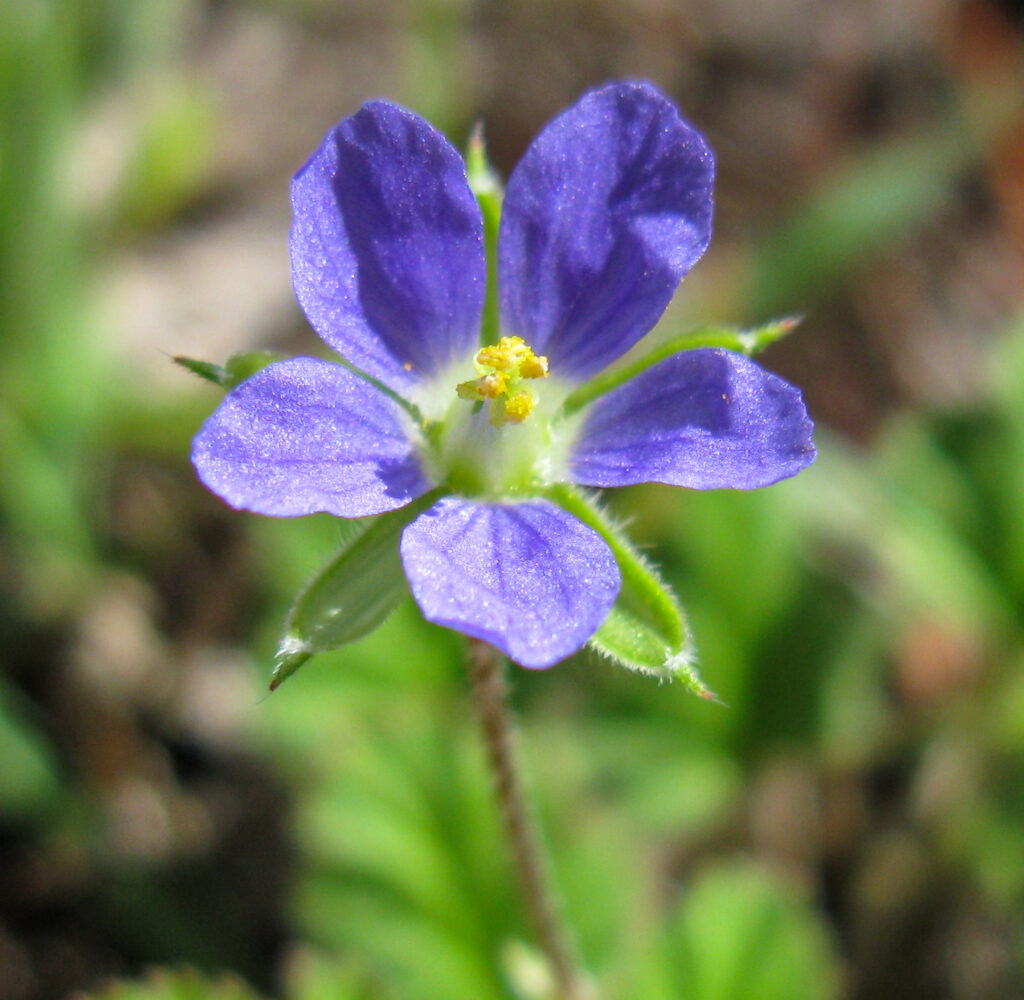
Inflorescence: Umbels (1-)4-6 flowered; pedicels covered with long simple hairs; sepals lanceolate to narrow-oblong, 0.6-1.0 cm long, 0.2-0.3-cm wide with long suberect white simple hairs and very short glandular hairs in bud, with a short mucro, ciliate and membranous towards the margin; flower bud rather a flat oval (other Australian sp. tend to have round flower buds); petals 1.0 cm long, 0.5 cm wide, elongate-ovate blue purple with yellow or white veins merging to form a yellow or white base; stamen filaments oblanceolate or narrow oblong, 0.4 x 0.15 cm; anthers and stigma yellow; staminodes one-third length of stamens, ovate triangular, almost obtuse, occasionally toothed.
Fruit: Mericarp 65 mm, covered in long white simple hairs; foveole – often has two folds beneath; beak 40-70 mm.
2n=40
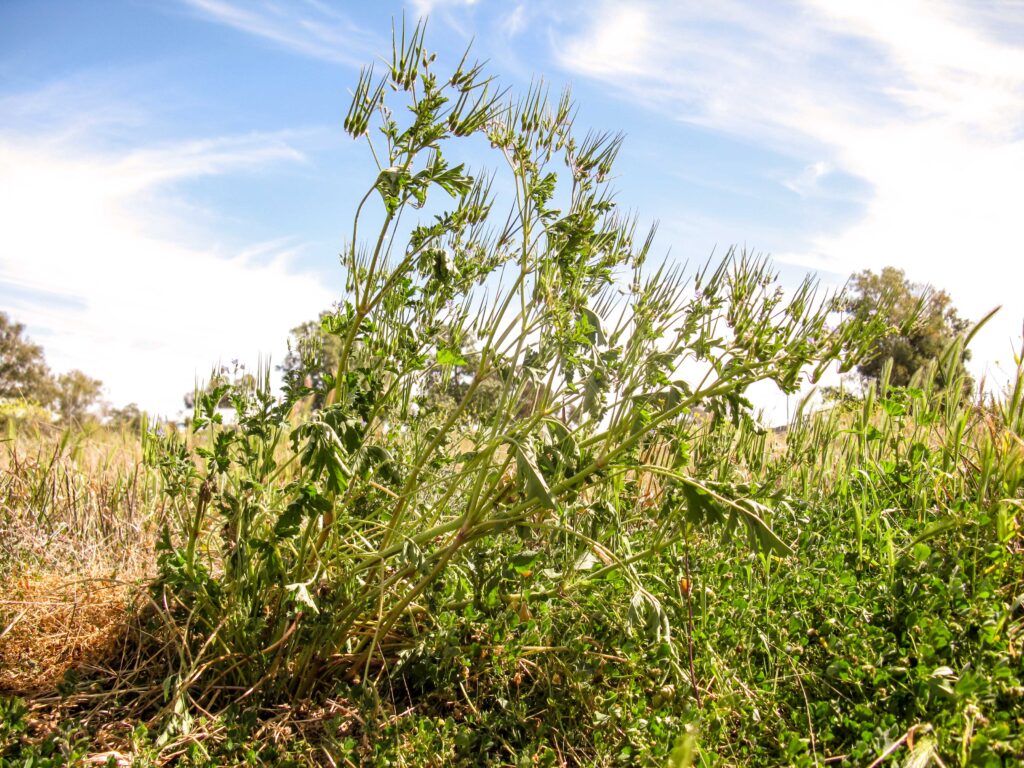
Distribution: endemic to Australia – central and east ; extra tropical southern and eastern Australia, as far north as the Musgrave Ranges in Queensland, rarely found in Western Australia; generally in open habitats.
The species is quite variable, plants from Western Australia tend to have virtually glabrous pedicels and larger stminodes. towards the east coast the leaves tend to be more dissected and the lobes somewhat narrower.
Notes: plants with beaks longer than 70mm are likely to be E. cygnorum
First published in Proc. Linn. Soc. New South Wales 83: 93 (1958)